Your shopping cart is empty!



"The Recognized Technical Experts in Our Field"
Hand held or portable heat sealers are useful in many scenarios where traditional tabletop or free-standing sealers are not ideal. They are frequently used for sealing large bags and drum liners, situations in which it is easier to bring a sealer to a pouch than a pouch to a sealer.
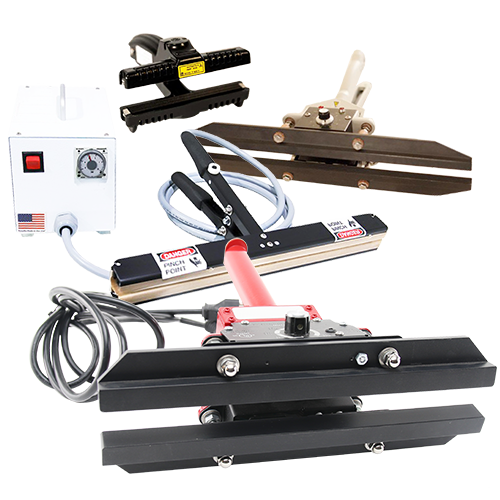
The two primary factors to consider when choosing a hand-held sealer are the clamp style and the heating technique. Depending on the application, the size of the pouch being sealed or bag being created, and other factors, users may prefer the scissor style over the T-shaped clamp, or the speed of constant heat over the safety of an impulse sealer.
This is one of the more common designs for hand-held heat sealers. With the handles and pivot point centered behind the seal bars, you get uniform pressure along the length. For wider seals, this angle also makes it easier to have full contact of the seal bars. For most users, having it open and ready to position the packaging makes for a quick and easy seal. For some projects that require a more careful hand, look for T-Clamp style impulse sealers with a spring assisted closed neutral position. The clamp can grip the material so you don't have to hold while sealing.
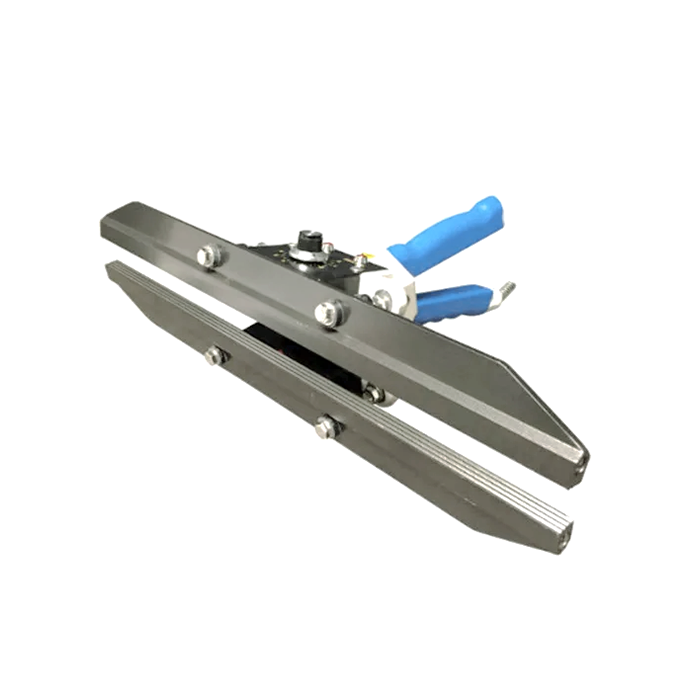
One of the more well known styles of sealers, thanks to tabletop impulse heat sealers and curling irons for hair, the scissor sealer leaves a wide and easy to maneuver seal area that mimics the scissor motion operators already know. The downside to this style is having the handle / pivot point on one side means getting uniform pressure along the seal length is almost impossible. The part of the seal bar closest to the handle will meet and get more pressure vs the outside edge. For shorter, quick seals this can be fine, but for longer seal lengths this can cause some issues.
The constant heat sealer is based on a traditional technology used in variety of applications. At its most simple, a constant heat iron is a device with a flat sealing surface that heats up and remains at a constant temperature until turned off. This is the same principal as metal rods left in fire to heat up, home clothes irons, and the more robust industrial handheld sealer with temperature controllers.
One of the drawbacks of this style of sealer is that, as the name indidcates, it remains hot the entire time it's switched on. Besides requiring more time to heat up and cool down, this means that the unit represents a burning hazard while in use, including between seals. Attention must be paid to carefully handling the device while it is on, and even for a short time after production. For projects with longer intermittent breaks between seals, the hot surface will remain a hazard, particularly if left in the wrong place. Conversely, for projects where a lot of movement and quick sealing is required, constant heat is a great choice. It does not have the (slight) delay in engaging a seal like an impulse unit does, and can work through thicker materials more reliably, but can run into issues with thinner or more thermally reactive materials. Because the temperature is constant, operators can overheat a seal and cause the base material to deteriorate.
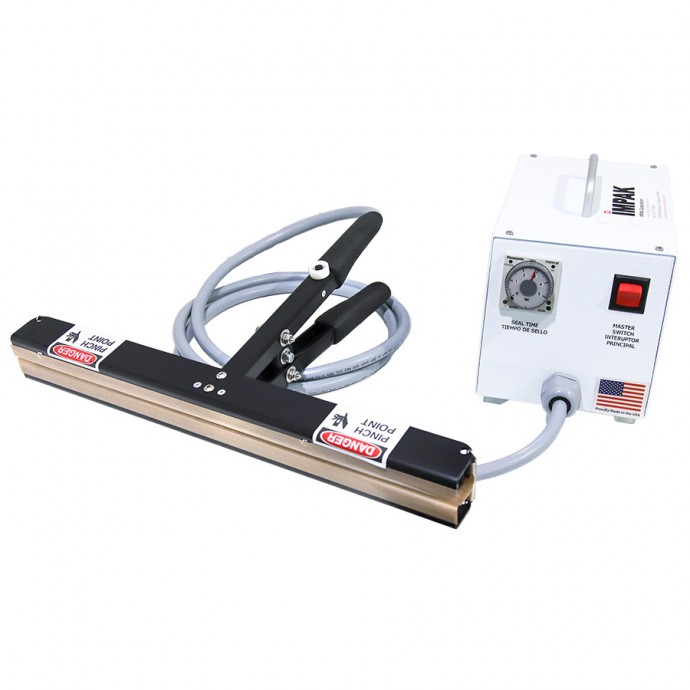
Impulse sealers were developed to offset the hazards associated with constant heat sealers. Instead of a large metal surface that is electrically heated, these units feature a thin strip of metal covered by heat-resistant Teflon tape. A current is applied to this element and the metal's natural resistance causes the it to heat up as electricity flows through it, similar to how a light bulb operates. Providing heat this way allows for a very quick ramp up and cool down time, unlike the consant heat sealer, making the unit cool to the touch between seals. This more controlled temperature makes it better for poly coated or thermo-plastic packaging materials like Polyethylene and Polypropylene - or for high performance materials with a small working seal temperature range like Tyvek®.
One of the main drawbacks to an impulse sealer is the introduction of consumables. Both the teflon tape, and heating elements will need to be replaced periodically. While those consumables are relatively inexpensive, they do represent an ongoing cost. The benefit to this system is it allows for smaller and more affordable sealing models to be produced. Rather than needing to rely upon an element or the teflon infused seal bars to remain in good working order, the replacement pieces can be swapped out year after year.