Your shopping cart is empty!



"The Recognized Technical Experts in Our Field"
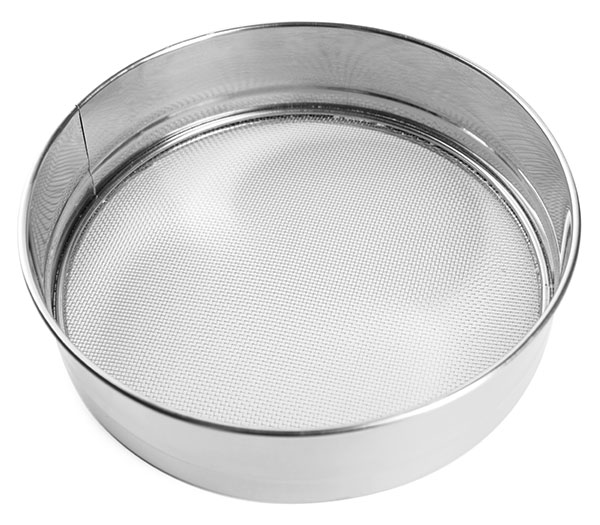
Sieve with mesh for desiccant sizing
The mesh size system is a standardized way to describe the particle size of granular materials, including bulk desiccants like silica gel and molecular sieves. It is based on the number of openings in a linear inch of wire mesh used in a sieve for sorting these kinds of materials. The number of openings is inversely proportional to the size of the openings, so larger mesh size numbers indicate smaller granules. For example, a mesh with 4 openings per inch will allow much larger particles to pass through than a mesh with 100 openings per inch.
Bulk desiccant listings will often include particle sizes in millimeters, microns, and/or inches along with a mesh size. The mesh size corresponds to the largest desiccant bead diameter for that product. For instance, 4 mesh indicates particles that are 4.75 mm or smaller, and 100 mesh corresponds to particles that are 0.149 mm or smaller. See the accompanying table for a range of common U.S. mesh sizes and corresponding particle sizes.
Desiccants are also listed as falling within a range of mesh sizes, usually expressed as “8x12 mesh” or “8-12 mesh,” for example. This indicates that the desiccant beads fit through the first mesh size, but not the second. An 8x12 mesh desiccant will therefore include beads that are approximately 1.7 to 2.3 mm in diameter. See the table at the bottom of this page for an extensive list of U.S. mesh sizes.
| U.S. Mesh Size | Applications | Reasons |
|---|---|---|
| 4x8 Mesh ≈ 2.4–4.8 mm Large beads |
|
Very low pressure drop (air flows easily), high crush strength for tall packed beds, minimal dust carryover |
| 6x12 Mesh ≈ 1.7–3.3 mm Medium-large |
|
Good balance of surface area vs. low dust, flows well in automated filling lines, more robust than smaller granules |
| 8x16 Mesh ≈ 1.2–2.4 mm Medium beads |
|
Higher adsorption rate than 6–12 mesh, still manageable dust levels, widely accepted “standard” size in specs |
| 16x30 Mesh ≈ 0.6–1.2 mm Small granules |
|
Faster adsorption kinetics (more surface area); better for low humidity, small volume environments Drawbacks: more dust, reduced airflow, lower mechanical durability |
| 30x60 Mesh ≈ 0.25–0.6 mm Fine grains |
|
Faster adsorption, better contact efficiency, compact bed performance Drawbacks: low airflow, dust handling challenges, requires containment |
| -200 Mesh < ~0.07 mm Powder / flour |
|
Maximum surface area, can be mixed directly into materials Drawbacks: dusting, caking, poor flowability, containment challenges |
The table below shows standard U.S. mesh sizing and the corresponding diameters for all types of particulate products.
| U.S. MESH | MILLIMETERSMM | MICRONS | INCHES |
|---|---|---|---|
| 3 | 6.730 | 6730 | 0.2650 |
| 4 | 4.760 | 4760 | 0.1870 |
| 5 | 4.000 | 4000 | 0.1570 |
| 6 | 3.360 | 3360 | 0.1320 |
| 7 | 2.830 | 2830 | 0.1110 |
| 8 | 2.380 | 2380 | 0.0937 |
| 10 | 2.000 | 2000 | 0.0787 |
| 12 | 1.680 | 1680 | 0.0661 |
| 14 | 1.410 | 1410 | 0.0555 |
| 16 | 1.190 | 1190 | 0.0469 |
| 18 | 1.000 | 1000 | 0.0394 |
| 20 | 0.841 | 841 | 0.0331 |
| 25 | 0.707 | 707 | 0.0280 |
| 30 | 0.595 | 595 | 0.0232 |
| 35 | 0.500 | 500 | 0.0197 |
| 40 | 0.400 | 400 | 0.0165 |
| 45 | 0.354 | 354 | 0.0138 |
| 50 | 0.297 | 297 | 0.0117 |
| 60 | 0.250 | 250 | 0.0098 |
| 70 | 0.210 | 210 | 0.0083 |
| 80 | 0.177 | 177 | 0.0070 |
| 100 | 0.149 | 149 | 0.0059 |
| 120 | 0.125 | 125 | 0.0049 |
| 140 | 0.105 | 105 | 0.0041 |
| 170 | 0.088 | 88 | 0.0035 |
| 200 | 0.074 | 74 | 0.0029 |
| 230 | 0.063 | 63 | 0.0024 |
| 270 | 0.053 | 53 | 0.0021 |
| 325 | 0.044 | 44 | 0.0017 |
| 400 | 0.037 | 37 | 0.0015 |