Your shopping cart is empty!



"The Recognized Technical Experts in Our Field"
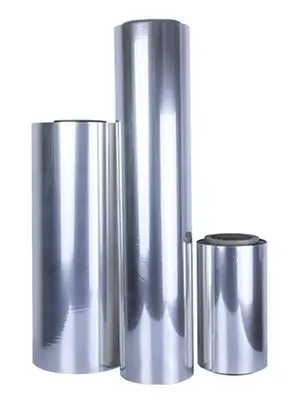
Vacuum-metalized polyethylene or VMPE is a plastic film that has been coated with an extremely thin layer of metal, usually aluminum, using a vacuum metallization process. It can offer several advantages for flexible packaging compared with conventional metalized or non-metalized polyester films commonly known as Mylar®. The main benefits are flexibility, heat-sealing compatibility, potential material-cost savings, and the ability to combine a metallic appearance with polyethylene's practical packaging properties.
The important distinction is that polyethylene film and polyester film (PET, often called Mylar®) have different properties. Vacuum metallization improves certain barrier properties and creates a reflective, metallic appearance, but it does not make the underlying plastics interchangeable.
1. Better compatibility with polyethylene-based packaging structures
Metalized PE is especially useful when the package needs a PE sealing layer or when manufacturers want to build a structure with PE as its primary film component. Depending on the film grade, it can help simplify a laminate, reduce the need for a separate PE layer, or support a structure designed for polyethylene recycling.
2. Heat-sealing and pouch-conversion advantages
Polyethylene is widely used for its heat-sealing properties. Metalized PE can be advantageous in packaging structures that need PE-compatible seals, pouch fabrication, or compatibility with existing PE converting processes. However, the exposed surface, coating design, and metalization side matter: a metalized surface is not automatically a suitable heat-seal surface.
3. Potential cost and material-efficiency benefits
Depending on film thickness, resin grade, production scale, and the complete laminate design, metalized PE may help reduce total material costs or eliminate a separate film layer. PE can also be a practical choice for applications where PET's greater stiffness and dimensional stability are unnecessary.
Cost savings are application-specific; metalized PE is not always cheaper than metalized PET.
4. Lightweight, flexible construction
PE is generally more pliable than PET and can be useful for squeezable pouches, flexible bags, liners, and packaging that must conform around a product. The metallic layer can provide an attractive silver finish without requiring a thick sheet of metal.
5. Potential support for PE-based recyclable packaging
Metalized PE may be incorporated into a predominantly PE structure, which can be advantageous when designing packaging for compatible PE recycling streams. This is not an automatic benefit: metallization, inks, adhesives, coatings, and other layers must all be evaluated against the applicable recycling guidelines and local collection infrastructure.
“Mylar” is a DuPont trademark associated with polyester film, not a generic name for every metallic-looking packaging film. The comparison below distinguishes the underlying film from its metalized version.
| Property | Metalized PE | Mylar-type foil laminate |
|---|---|---|
| Flexibility | Typically more pliable | Stiffer, dimensionally stable |
| Heat sealing | Often suitable, depending on grade and surface | Usually needs a separate sealant layer |
| Tensile strength and stiffness | Generally lower | Generally higher |
| Temperature resistance | Generally lower | Generally higher |
| Moisture and oxygen barrier | Depends heavily on grade and coating quality | Often strong barrier performance |
| PE-based structure potential | Strong | Requires additional PE layers for a PE-based laminate |
Metalized PET is commonly chosen when stiffness, dimensional stability, print performance, and barrier performance are priorities. Metalized PE is attractive when flexibility, sealing compatibility, and a PE-centered package design matter more. Actual barrier performance depends on the substrate, metallization quality, and finished structure.

Box liner made from VMPE
Vacuum metalization deposits an extremely thin layer of aluminum onto the film. That layer can substantially improve resistance to water vapor, oxygen, and light compared with an uncoated film. However, the improvement depends on the substrate and the integrity of the metal coating.
For demanding applications, compare:
Do not assume metalized PE provides a better barrier than metalized PET. If long shelf life, oxygen-sensitive products, or stringent moisture protection are critical, metalized PET may be the better choice—or another high-barrier structure may be necessary.
Although a PE-based structure may be designed with recycling in mind, metallization itself can complicate recycling. How2Recycle identifies metalized layers as a feature that may require technical compatibility testing for PE films. Therefore, metalized PE should not automatically be described as recyclable simply because polyethylene is its primary polymer.
If you are uncertain whether VMPE is an appropriate material for your application, contact IMPAK and ask our materials experts.