Your shopping cart is empty!



"The Recognized Technical Experts in Our Field"
Mylar® is the trade name for a polyester film whose scientific name is biaxially-oriented polyethylene terephthalate, or BoPET. When used as part of a laminate structure, e.g., BoPET / aluminum foil / LLDPE, Mylar® provides substantial barrier against moisture and gas, notably oxygen, and can be converted into heat-sealable pouches. Mylar® films have become indispensable in several industries, including food packaging, electronics, chemicals, and aerospace, for its exceptional ability to act as a barrier against environmental damage while remaining lightweight and durable.
BoPET film was developed in the mid-1950s, originally by DuPont, Imperial Chemical Industries (ICI), and Hoechst. The term "Mylar" is presently a registered trademark of the DuPont Teijin Corporation.
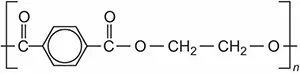
Chemical structure of polyethylene terephthalate
Fabrication of Mylar involves stretching or "drawing" rolls of PET (polyethylene terephthalate) film first in the direction the roll is fed into a machine and then in the transverse direction, hence making it biaxially oriented. This process alters the molecular orientation of the film, which is then "heat set" to fix the material in that state and prevent it from shrinking. The result is a film with high tensile strength, chemical and dimensional stability, transparency, reflectivity, gas and aroma barrier properties, and electrical insulation.
The process described above is how "raw" Mylar® is created; that raw material is then usually used as the basis of a lamination. This means that the BoPET is combined with other materials such as aluminum (for added barrier) and polyethylene (as a sealant layer) to create a material structure that works better for converting into packaging or other applications. Because BoPET is the base layer of these laminations, the resulting material is usually still referred to as "Mylar" or, when appropriate, Mylar Foil.
Plastic films such as polyethylene, polypropylene, and nylon each have qualities that make them suitable for specific applications. These are the characteristics of Mylar that make it one of the most valued films on the market:
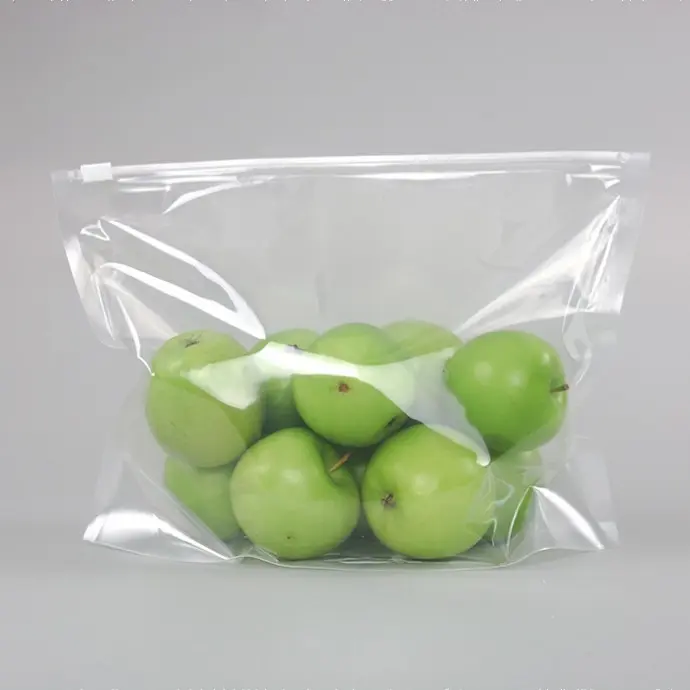
Clear Mylar pouch with apples
There is a common misconception that Mylar® is normally silver in color, likely due to the prevalence of Mylar balloons. Actually, raw Mylar film is transparent. The silver color is a result of a foil layer, usually aluminum, being added to the polyester. Furthermore, "Mylar" pouches are often produced with a color element added to the lamination, even vibrant full-color printing of images and graphics. So the reality is that what we call Mylar can be clear, silver, or any color imaginable.
When a metal barrier layer is included in a Mylar structure, it is done either by adhesive lamination of a very thin sheet of aluminum, or vacuum metallization. The latter is also known as thermal evaporation, and is the most common PVD (Physical Vapor Deposition) process used to apply metal alloys under vacuum. In this process, aluminum is vaporized inside a vacuum chamber and then bonded to a polyester sheet to achieve a uniform metallized layer and the familiar silver color.
Keep in mind that even with a foil layer, a Mylar lamination can be produced in a variety of colors and with full custom print. There are also clear high barrier film structures that include a transparent metallized layer, facilitating production of pouches that allow the product inside to be visible while providing protection from moisture and oxygen. At the current state of lamination technology, structures with an opaque foil layer still provide a superior barrier.
We offer Mylar® pouches in a vast variety of sizes, shapes, colors, thicknesses, and with many features: zipper closures, spout fitments, tear notches, frangible seams, and more.
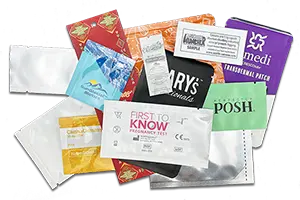 MiniPouches
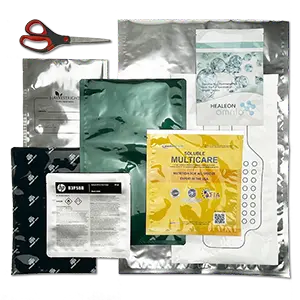 Medium Foil Bags
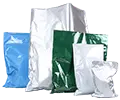 Large Foil Bags
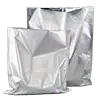 Heavy Duty
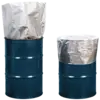 High Barrier