Your shopping cart is empty!



"The Recognized Technical Experts in Our Field"
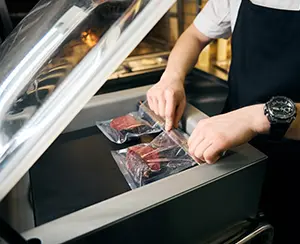
When most people think of a vacuum machine, they think of a device that sucks air through a hose. This is the principle by which many vacuum sealers work, particularly nozzle style vacuum sealers. The nozzle goes inside a pouch, removes the air, and then retracts so that the pouch can be immediately sealed.
Chamber vacuum sealers seem to operate by magic in comparison, but they work on a variation of the same principle. A pouch is placed inside the highly-reinforced, air-tight chamber, with the pouch's open end aligned on top of the heat sealing element. When the lid is closed, a pump then removes all the air from the chamber, including the air inside the pouch. The bag is then heat sealed while still under vacuum, after which air is released back into the chamber and the pouch remains sealed tight and air-free.
It is widely held that a chamber unit is superior to other types of vacuum sealers because the inside of the pouch being evacuated is at an equal state of pressure with the chamber cavity when the pouch is sealed. Without a difference in air pressure, no pressurized air will seep into the bag before the seal is completed. Chamber sealers are also better for sealing powders and liquids (e.g., sous vide) because there is no nozzle inside the pouch liable to draw in those types of contents.
To start, place your product in a vacuum pouch that has been specifically chosen for your product and application. Keep in mind that not all vacuum pouches are the same. For chamber sealers, a pouch made from a smooth film is preferrable to a textured film. Most vacuum pouches consist of only one thin layer of nylon material to provide the air transmission barrier that is required for vacuum packaging. Other pouch materials like Mylar foil provide a much higher barrier and are better for long term quality assurance.
With a chamber unit, you must make sure that the dimensions of the pouches are correct for your product and for how they fit with the chamber and seal bar. There needs to be enough space between the top of your product and the open top of the pouch to allow the top of the pouch to lay across the machine’s seal bar in a relaxed manner. This will ensure the best quality seals on the pouch every time. A material product specialist can help you to spec in the right pouch for your product.
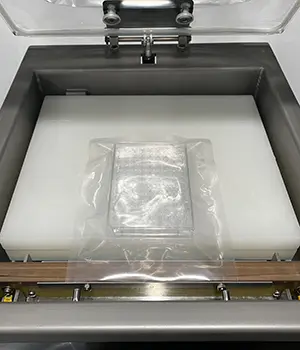
Once your product is inside the vacuum pouch, the next step is to place the pouch(es) inside the chamber. Each pouch should be placed so that the open end is on top of the heating element. If you are using the optional gas flush feature on your chamber sealer, then the small gas nozzles should be pointing into the opening of the pouch. Check to make sure that no part of the pouch opening protrudes outside of the chamber. This is important, because if any part of the bag is outside the chamber, packaging of your product will not be achieved and the pouch may even burst.
Once the pouch with your product inside is properly placed inside the chamber, simply close the lid and the vacuum cycle will begin. In most cases, you will want to allow the vacuum cycle to continue until the maximum vacuum that the pump in the machine can pull has been achieved. This will result in a very tight package once the entire cycle has been completed.
When a pouch is vacuum sealed, it puts the product inside under a significant amount of pressure. This will not damage most items. However, if your product is delicate, it is recommended that only a light vacuum should be applied to prevent the product from being damaged. The drawback to doing this is that it will allow a small amount of oxygen to remain in your package once it is sealed. A gas flush cycle (optional on most models) can be added after the vacuum cycle. Flushing the pouch with an inert gas such as nitrogen maintains enough pressure inside a pouch to prevent it from collapsing on your product at the end of the cycle, while keeping the residual oxygen level as low as possible.
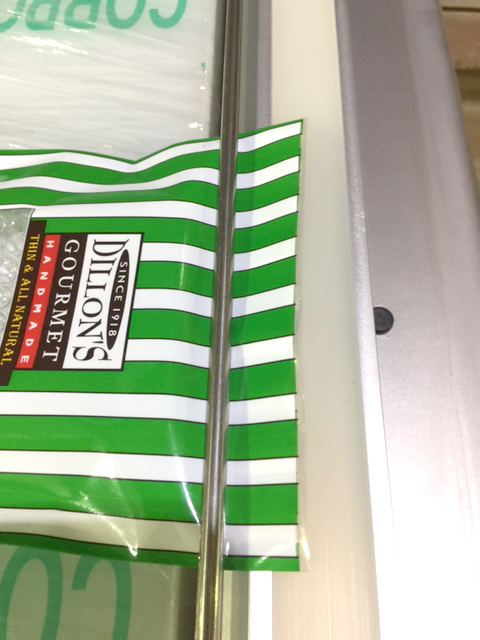
Figure 4
During the vacuum cycle, air rushes out of the chamber at a greater rate than it escapes from inside your package. This allows the pressure inside the package to be a little higher than in the surrounding chamber. This is normal and should diminish as the vacuum cycle continues. Looking through the clear acrylic lid (standard on many chamber sealers), you can check to make sure the end of your pouch does not pull away from the seal bar.
You will also notice that at this point, the pouch will not have the "compressed" look distinctive with vacuum sealing as the chamber and pouch are still in equilibrium. For units without a clear lid, pouches will need to be checked after sealing. Many machines also offer a simple pouch holding mechanism (Fig. 4) to help make sure the end of the pouch stays properly placed over the seal bar.
The open end of the pouch needs to be heat sealed completly to prevent air from entering the package at the end of the vacuum cycle. The sealing of the pouch is accomplished in most chambers with a simple time-based impulse seal system. However, if your pouch material has a very narrow seal temperature window or your package must be validated, you may require an optional temperature controlled or even a validatable seal system. Be sure to talk over your specific product and application needs with an IMPAK vacuum sealing equipment specialist.
The video below shows a chamber vacuum sealer equipped with our Siemens-based iS2 control system, which provides precise control of seal time, temperature, and pressure, and allows for easy validation.
Once your package is sealed, a valve in your chamber sealer opens and allows outside air to go back into the chamber cavity and then for the lid on your machine to open. If only a vacuum cycle and a seal cycle were completed the pouch will be compressed very tightly around your product at this point. If a gas flush was added, then depending on what volume of gas was introduced to the inside of your pouch, the disposition of the pouch may be anywhere from firm to very loose around your product. However, in all cases the residual oxygen inside your package will be very low.
Chamber vacuum sealers are the most flexible type of vacuum sealers as they allow for the vacuum sealing of both liquids and solids as well as allowing for extremely low residual oxygen even when working with delicate products.
Chamber sealers are the best option for vacuum sealing powders and liquids for multiple reasons. With a nozzle style vacuum sealer, the nozzle is inside the pouch very close to the product, pulling air with speed and force through a narrow opening. As you can imagine, this is fine for solid products, but powders and liquids tend to get sucked into that nozzle during the vacuum cycle. Not only do you lose some amount of product, but the nozzle can get clogged and the sealer can be damaged.
A chamber vacuum sealer works best, as the pressure inside the vacuum bag reduces at the same rate as the internal pressure in the chamber. Because of this, the powder or liquid* stays inside the bag instead of being sucked out of the opening. Also, the chamber vacuum sealer requires no wait time between seals and there is no mess.
*IMPORTANT NOTE: When sealing liquids in a chamber sealer, make sure the contents inside the bag are cooled below 100°F before sealing. As the pressure in the chamber reduces, so does the boiling point of the liquid, which can cause the liquid to boil out of the bag. This is because when the air pressure drops, the atmosphere exerts less force on the liquid's surface, and the liquid molecules escape into the gaseous phase at lower temperatures.
IMPAK provides two options for preventing liquid or powder products from spilling out of their bags when placed in a chamber vacuum sealer.
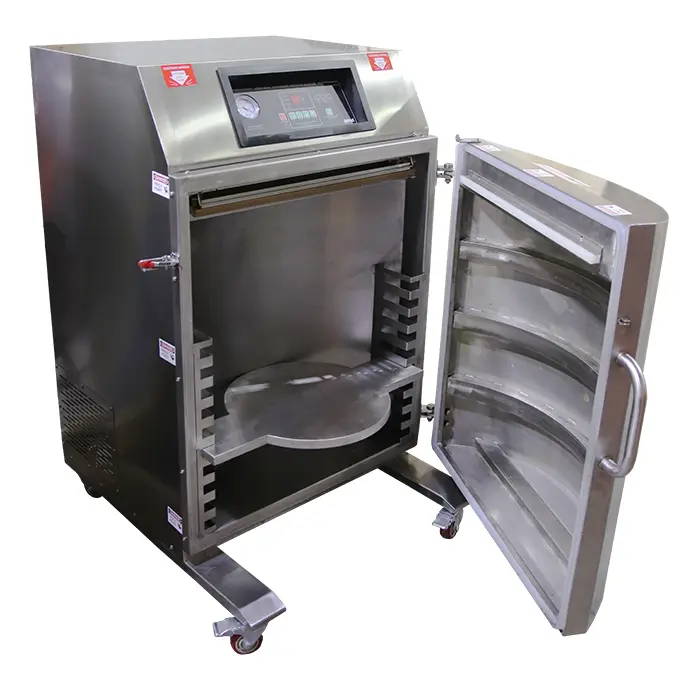
A vertical chamber sealer features a door on the front of the machine to access a chamber with an adjustable shelf on which filled pouches are placed, and a seal bar located near the top of the chamber.
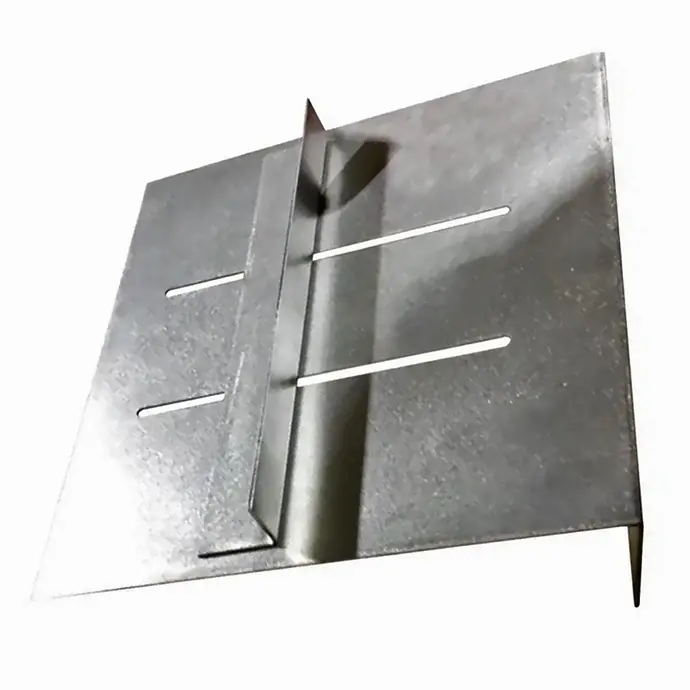
A stainless steel tray designed to sit inside the chamber of a sealer to keep pouches at an angle, helping to kep contents in place. This is an optional add-on for many traditional horizontally-oriented chamber sealers.
The video below shows the sealing process with a Gramatech Chamber Sealer with slanted tray